.png)
The quiet moment that decides everything
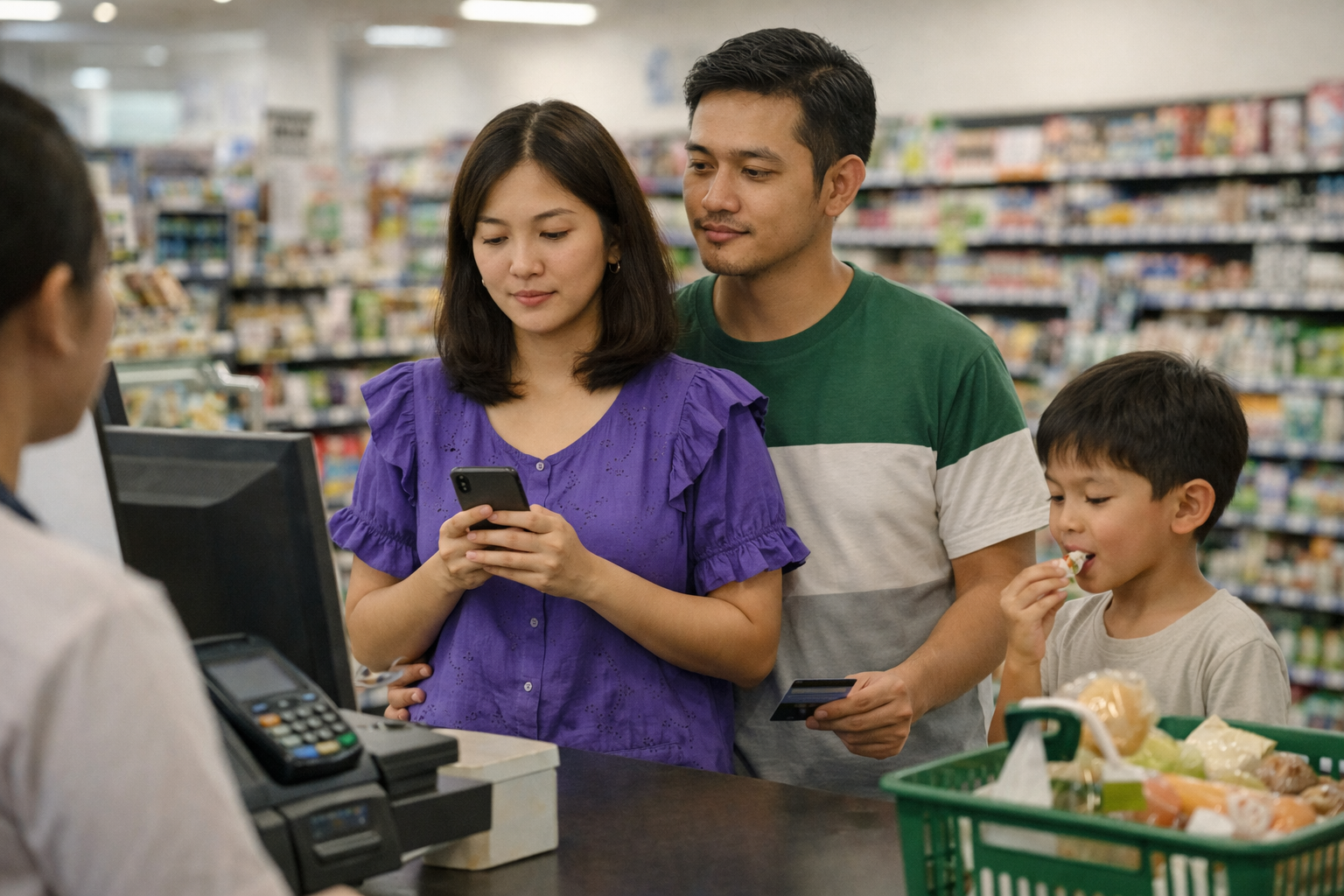
Every second, across cities, towns, and neighborhoods in Southeast Asia, a moment occurs that quietly decides the fate of brands. It does not announce itself or demand attention. A cashier scans a barcode, a soft beep sounds, a receipt prints, and the shopper walks away.
Yet inside that ordinary exchange sits the most consequential decision in commerce.
A real person, in a real store, with real money, has chosen one SKU over another. That single action answers questions brands spend millions trying to infer: whether the shopper chose your brand or your competitor’s, whether they traded up or down, whether a promotion mattered, whether this was a first trial or a repeat purchase, and whether they are likely to come back.
No survey captures this with certainty. No attribution model resolves it cleanly. No probabilistic curve settles the matter.
The checkout does.
And that is the paradox of modern commerce: not that brands lack data, but that the most decisive data point in the entire consumer economy remains largely invisible to the people responsible for growth. This is the invisible checkout.
The POS system: the market’s most honest witness
At the center of this moment sits the POS system — the most honest witness the market has. Unlike media platforms, it does not speculate. Unlike surveys, it does not ask for opinions. Unlike models, it does not smooth or infer.
It simply records what happened.
Which SKU moved.
At what price.
In which store.
At which moment.
In what quantity.
Every beep is a fact. Every transaction is a resolved outcome.
The POS system does not care how proud a brand is of its creative, how clever its targeting was, or how impressive the media plan looked in a presentation. If the SKU did not move, the market has voted. If it moved strongly in one micro-region and not another, the market is whispering something very specific.
And yet, for most brands, POS data lives in a strange in-between state. It is mission-critical for finance, yet structurally distant from marketing. It is essential for sales, yet locked behind reporting cycles that make it reactive rather than directive. It is accurate, but rarely available when decisions are still reversible.
Two parallel universes that barely speak
Modern CPG organizations operate across two parallel universes.
The first is the fast, probabilistic universe of marketing. Dashboards refresh constantly. Campaigns are optimized within hours. Performance is measured through impressions, reach, clicks, CPMs, viewability, brand lift, and modeled incrementality. This universe is powerful, but it speaks in probabilities. It tells you what might be happening.
The second is the slow, deterministic universe of sales. POS reports arrive weekly, monthly, or even quarterly. Data is aggregated. Stories are smoothed. Reality shows up long after the moment of influence has passed. This universe is precise, but painfully slow. It tells you what already happened.
Between these two worlds sits a widening gap — one that most organizations have come to accept as inevitable.
Grivy exists because it isn’t.
How commerce intelligence was pushed to the sidelines
In the first issue of this series, we described how commerce intelligence has spent years playing the role of the intern in the corner. Always present. Rarely empowered.
Commerce teams were expected to reconcile numbers after campaigns ended, validate results once budgets were spent, and explain gaps when reality failed to match forecasts. Meanwhile, the steering wheel was handed to media platforms and creative optimization engines that could move faster, even if they were acting on less certain signals.
This imbalance wasn’t malicious. It was structural.
Marketing technology evolved at internet speed. Offline commerce infrastructure did not. Digital media became instant. POS remained delayed. Over time, an unhealthy norm took hold: marketing metrics were used to decide, while POS data was used to justify later.
That single pattern explains why so many brands struggle to defend marketing ROI in front of finance. CFOs do not operate on impressions or click-through rates. They operate on revenue, margin, and return on invested capital. POS is the language finance understands. When marketing cannot speak it fluently, credibility erodes.
Offline POS: the economy’s most underused asset
Offline retailer POS data is the circulatory system of the consumer economy. Every meaningful commercial outcome flows through it: brand choice, price sensitivity, promotion effectiveness, assortment relevance, innovation success or failure, and long-term loyalty.
Yet despite this importance, POS data remains fragmented and underutilized. Large retailers guard it inside closed ecosystems. Smaller chains often lack the infrastructure to share it. Independents sit in near-total darkness. Brands receive partial views, filtered through category reports and delayed exports, stripped of SKU-level nuance and disconnected from audience exposure data.
The result is a structural imbalance. The most accurate data arrives too late. The fastest data is the least certain.
This is why the provocation at the heart of this series matters: POS data will become the new global currency of marketing ROI. Not one metric among many. The metric. Not because it is fashionable, but because it is unavoidable.
When the checkout becomes a live signal
To understand why POS becomes a currency rather than just another metric, it helps to rethink what a POS event actually represents.
A POS event is not simply “sales data.” It is a behavioral resolution point.
Before a purchase, the world exists as a cloud of possibilities. A shopper might respond to an ad. They might notice a shelf display. They might be influenced by a price cut. They might try a new pack or flavor. Marketing models live in this probabilistic space, estimating likelihoods and correlations.
But the moment the barcode is scanned, uncertainty collapses.
POS pings and the collapse of uncertainty
In quantum physics, particles exist in a probability wave until they are observed. Observation collapses that wave into a single reality. Commerce behaves the same way.
Before purchase, everything is hypothetical. After purchase, everything is factual.
That single POS ping resolves questions teams debate for weeks: did they buy, which SKU, which pack, which store, which channel, which moment, and at what price. There is no confidence interval around a scanned barcode. There is no modeled lift to interpret. There is only truth.
This is why brands that begin working with near-realtime POS often describe the experience as initially uncomfortable and quickly addictive. Certainty removes excuses, but it also unlocks clarity.
Why averages feel safe — and mislead
Modeled metrics feel safe because they soften reality. They speak in averages. They allow interpretation. They preserve narratives.
POS does none of that.
If the SKU moved, it moved. If it didn’t, it didn’t.
In fragmented markets like Southeast Asia, where behavior varies dramatically by channel, region, and store type, averages are not just imprecise — they are misleading. Commerce does not happen at the brand level. It happens at the SKU level.
SKU-level truth, without negotiation
SKU-level POS data reveals truths brands often prefer not to see. A promo pack driving volume but eroding margin. An innovation growing share by cannibalizing existing buyers. A hero SKU performing well in hypermarkets but failing in minimarkets. A competitor winning not through media, but through distribution discipline.
SKU-level truth does not negotiate with your narrative. It reports what the market did.
Once brands begin operating at this level, the questions they ask change fundamentally. Not “Did the campaign work?” but “Which SKU worked, where, for whom, and why?”
Why this moment changes everything
This is the inflection point. When POS shifts from delayed to near-realtime, from aggregated to granular, from anonymous to identity-linked, and from siloed to connected, it stops being a reporting artifact.
It becomes a decision engine.
And once the checkout is no longer invisible, everything downstream begins to realign: media optimization, creative strategy, shopper journeys, innovation pipelines, retailer negotiations, and conversations with finance.
The beep at the till becomes the heartbeat of the organization.
Conclusion
The checkout has always been where commerce truly happens. What’s changing is our ability to see it clearly, at speed, and at scale. When POS data moves from delayed reporting to live intelligence, brands stop relying on assumptions and start making decisions grounded in how shoppers actually behave. The invisible checkout becomes the most reliable source of truth in an increasingly fragmented market.
Ready to turn POS into a growth signal?
Grivy helps brands connect offline POS truth with actionable commerce intelligence. Get in touch to see how your checkout data can power smarter marketing, sales, and growth decisions.
.png)